
A Community Bank's Guide to Lending Technology in 2026
Community banks must modernize lending without enterprise budgets. A practical guide to adopting AI lending tools that actually deliver ROI.
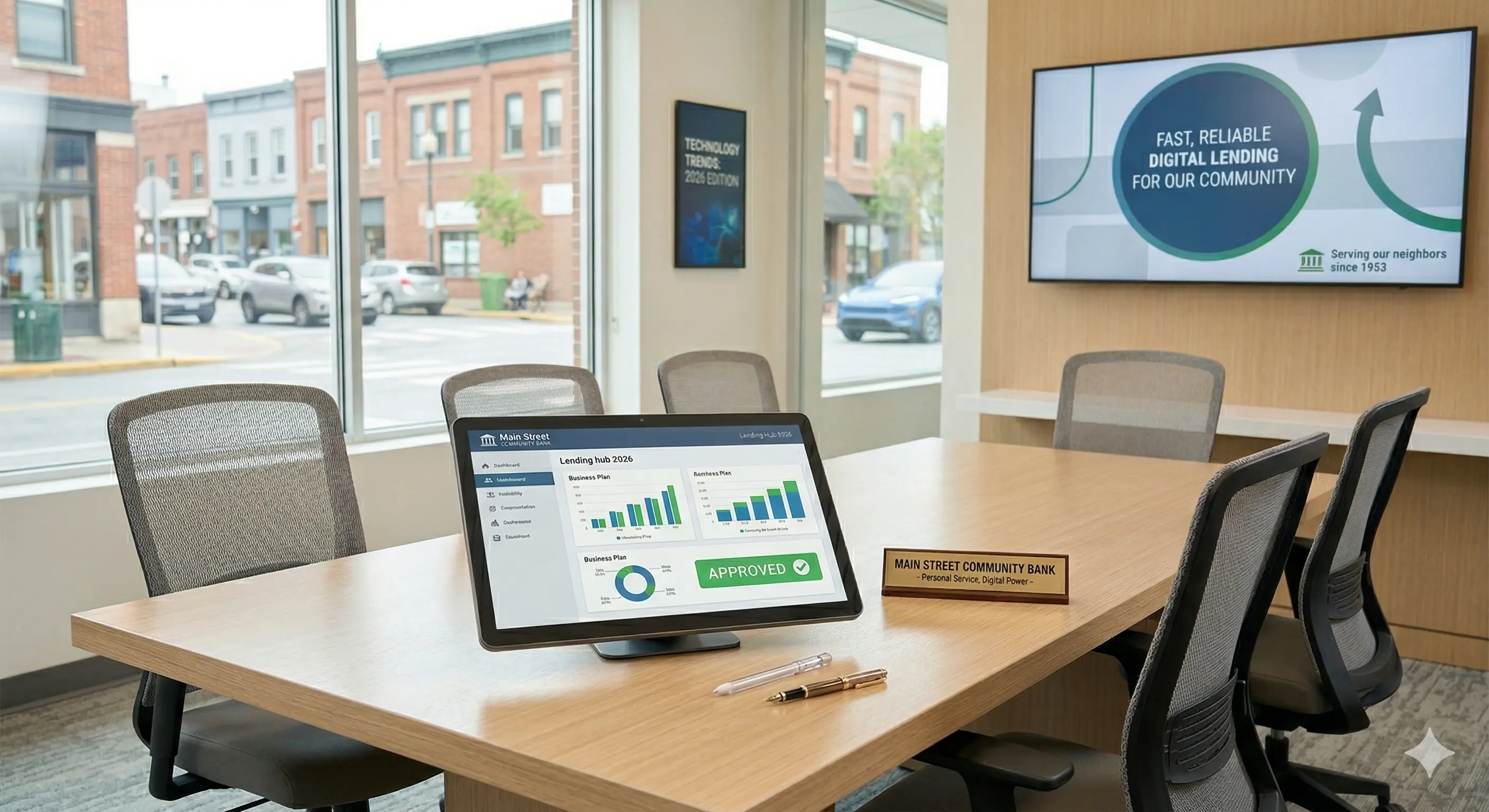
The Community Bank Dilemma
Community banks are caught between two forces. On one side, borrowers increasingly expect the speed and transparency they get from fintech lenders and large banks with dedicated digital platforms. On the other, community banks operate with lean teams and modest technology budgets that make enterprise loan origination systems impractical.
The result is a growing gap: community banks compete on relationships and local knowledge, but lose deals when their origination process takes two weeks while a competitor delivers a term sheet in three days.
Where Technology Makes the Biggest Difference
Not every part of the lending process benefits equally from technology investment. For community banks, the highest-ROI opportunities are in the middle of the workflow—between borrower intake and committee presentation:
Financial Spreading This is where most community banks lose the most time. A single analyst might spread 8–12 deals per month, spending 2–4 hours on each. AI spreading can reduce that to 15–20 minutes per deal, freeing 20–40 hours of analyst time monthly.
Document Management Without a central system, documents live in email attachments, shared drives, and physical folders. Even finding the right version of a financial statement can take 15 minutes. Centralized document management with automated classification eliminates this friction.
Credit Memo Generation Many community banks still write memos in Word, manually pulling numbers from spreadsheets. AI-assisted memo generation maintains the institution's template and standards while cutting preparation time by 70–80%.
Deal Pipeline Visibility Loan committees often lack a real-time view of the pipeline. Deals exist in different stages across different systems (or analyst's heads). A unified pipeline gives management visibility into volume, velocity, and bottlenecks.
Common Concerns (and Honest Answers)
"Our team isn't technical enough." Modern lending tools are designed for loan officers and analysts, not IT staff. If your team can use email and spreadsheets, they can use these tools. The learning curve is measured in hours, not weeks.
"We can't afford enterprise software." You don't need enterprise software. Cloud-based tools with per-seat or per-deal pricing make advanced capabilities accessible without six-figure license fees or multi-year contracts.
"AI will make mistakes." AI tools in lending are designed as assistants, not replacements. Every output—a financial spread, a classification, a memo draft—is reviewed by your analysts before it becomes official. The AI handles the repetitive work; your team handles the judgment.
"What about our examiners?" Automated processes actually improve examiner outcomes. AI-generated spreads are more consistent, memos are more thorough, and every data point is traceable to source documents. Examiners appreciate clean, auditable work papers.
"We'll lose the personal touch." The opposite is true. When analysts spend less time on data entry and document sorting, they have more time for borrower relationships—the very thing that differentiates community banks from larger competitors.
A Practical Adoption Roadmap
Community banks don't need to transform overnight. A phased approach works best:
Phase 1: Centralize documents and automate classification. Start with a single place for all borrower documents. Automated classification removes the most tedious manual step and gives immediate visibility into deal completeness.
Phase 2: Automate financial spreading. Once documents flow into a central system, connect AI spreading to automatically process financial statements as they arrive. Analysts shift from data entry to data review.
Phase 3: Add credit memo assistance. With clean spreads feeding into memo templates, AI can draft memos that analysts refine. This is where the biggest time savings compound.
Phase 4: Build pipeline visibility. With the core workflow automated, add deal tracking and pipeline analytics. Now management can see every deal's status, identify bottlenecks, and forecast volume.
Evaluating Lending Technology Vendors
With a growing number of tools targeting community bank lending, it's worth knowing what to look for:
Configurability. Does the tool adapt to your institution's templates, or do you adapt to the tool? Community banks have distinct spreading templates, credit policies, and memo formats. A tool that forces you into a generic output creates more work, not less.
Pricing model. Enterprise-style licensing with six-figure annual fees and multi-year contracts make sense for large banks — not community institutions. Look for per-seat or per-deal pricing that scales with your volume, with month-to-month or annual terms that don't require board-level budget approval.
Implementation timeline. The best tools are operational in days or weeks, not months. If an implementation requires your IT team, a systems integrator, or a six-month project plan, the tool wasn't built for community banking.
Support quality. Community banks don't have internal technical staff to troubleshoot software. Vendors should offer responsive support — ideally phone or chat, not just a ticket system — and proactive guidance on configuration.
Examiner track record. Ask whether the vendor has customers who have successfully presented AI-generated spreads and memos to OCC, FDIC, or state regulators. The answer tells you whether the tool is designed for real-world bank operations or just demos.
Calculating ROI Before You Buy
The ROI conversation for community banks usually comes down to two numbers: time savings and deal volume impact.
Time savings. For a team with two analysts each spreading 10 deals per month at 3 hours each, current monthly spreading time is 60 hours. At $45/hour fully-loaded cost, that's $2,700 per month. If AI reduces spreading time to 20 minutes per deal, the same volume takes 7 hours — saving $2,400/month or $28,800/year on spreading alone.
Deal volume. A more meaningful ROI question: if your analysts had 40 hours of freed capacity each month, how many additional deals could your institution close? If the average net revenue per closed commercial loan is $15,000 and your close rate is 50%, recovering enough capacity for even two additional deals per month adds $15,000 in monthly revenue — or $180,000 annually.
Against an annual subscription cost of $24,000–$60,000 for a typical community bank team, the math is clear.
The Competitive Reality
Community banks that modernize their lending operations aren't just saving time — they're defending their market position. Borrowers notice when a community bank can move as fast as a larger institution while still providing personalized service. That combination is hard to beat.
The technology exists today to close the speed gap without sacrificing what makes community banking special. The question isn't whether to adopt it, but how quickly.
Interested in how LendPipe is built specifically for community bank lending teams? See our community bank lending software overview or explore how financial spreading benchmarks compare across different institution types.