
DSCR Calculation for CRE Loans: Formula, Examples, and What Lenders Actually Look For
A practical guide to calculating DSCR for commercial real estate loans. Formulas, worked examples, common mistakes, and how lender types interpret it.
What Is DSCR and Why Does It Matter?
Debt Service Coverage Ratio is the single most important number in commercial real estate lending. It tells you whether a property generates enough income to cover its debt payments — and by how much. Every lender calculates it, every credit memo features it, and every examiner checks it.
But DSCR isn't as straightforward as it looks. How you define "net operating income" and "debt service" can swing the ratio by 0.2x or more — enough to turn an approval into a decline. This guide covers the formula, walks through real examples, and explains how different lender types approach DSCR differently.
The Basic Formula
DSCR equals Net Operating Income divided by Total Debt Service.
DSCR = NOI / Total Annual Debt Service
A DSCR of 1.0x means the property generates exactly enough income to cover its loan payments — no margin for error. A DSCR of 1.25x means there's a 25% cushion. Most lenders require somewhere between 1.20x and 1.50x depending on property type and risk profile.
Defining Net Operating Income (NOI)
NOI is where most DSCR disagreements happen. The basic definition is straightforward: gross rental income, minus vacancy and credit loss, minus operating expenses.
NOI = Gross Potential Rent - Vacancy Allowance - Operating Expenses
Gross potential rent is what the property would generate at full occupancy at market rents. Vacancy allowance is typically 5-10% for stabilized properties, higher for transitional or lease-up properties. Operating expenses include property taxes, insurance, property management fees, maintenance and repairs, utilities (if owner-paid), and reserves for replacement.
What you exclude from operating expenses matters: capital expenditures (treated separately), depreciation (a non-cash item), income taxes (entity-level, not property-level), and debt service itself (that's the denominator).
The most common source of error is using the borrower's stated NOI without adjusting for market vacancy, management fees (many owner-operators don't charge themselves a fee but a lender should impute one), and below-market or above-market rents on in-place leases.
Defining Total Debt Service
Total debt service is the annual sum of all principal and interest payments on the subject loan. If you're calculating on a proposed loan basis, use the proposed loan terms. If calculating on an existing basis, use actual payments.
For variable rate loans, most lenders calculate DSCR at the stressed rate — either the fully indexed rate, the rate cap, or a floor rate specified by policy. Using the initial teaser rate for DSCR gives a misleading picture of coverage.
An important question: do you include debt service on all property-level debt, or just the proposed loan? If the property has a first mortgage and you're underwriting a mezzanine position, your DSCR calculation should capture total debt service — not just your tranche. This is sometimes called "global DSCR" at the property level.
Worked Example: Multifamily Property
Consider a 50-unit apartment building with the following characteristics:
Gross potential rent is $60,000 per month ($1,200/unit), which equals $720,000 annually. Vacancy and credit loss at 7% equals $50,400. Effective gross income is $669,600. Operating expenses total $295,000 (property taxes $85,000, insurance $32,000, management at 6% of EGI equals $40,176, maintenance $48,000, utilities $35,000, reserves $18,000, other $36,824). NOI equals $374,600.
The proposed loan is $3,200,000 at 7.25% on a 25-year amortization. Annual debt service (principal plus interest) equals $280,320.
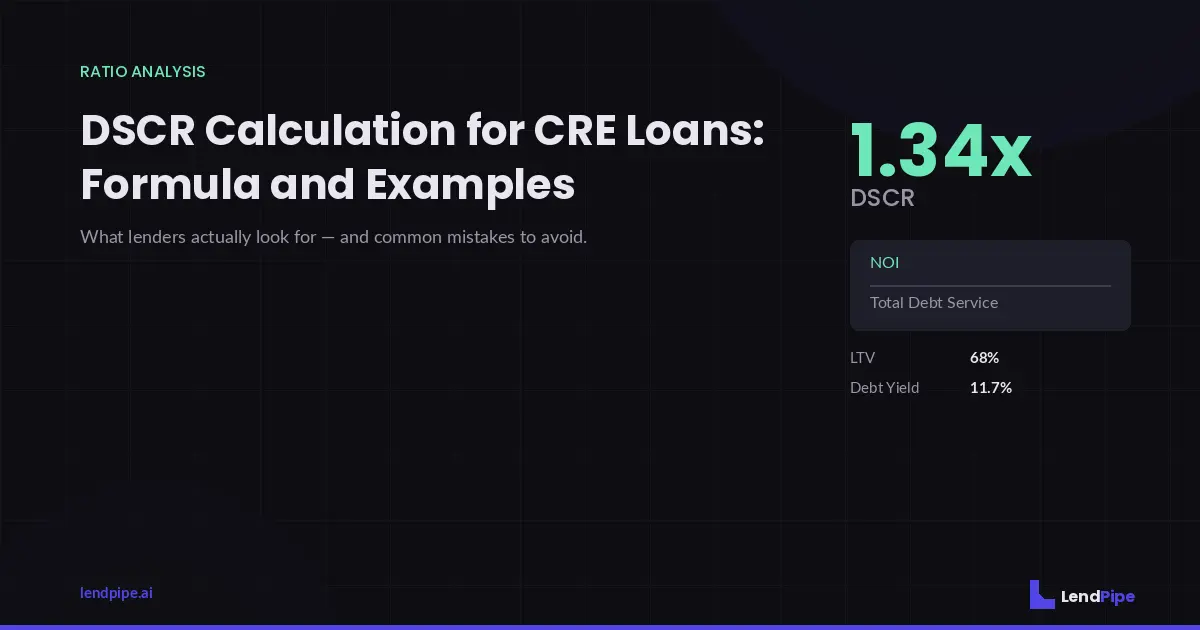
DSCR = $374,600 / $280,320 = 1.34x
At 1.34x, this deal would pass most lenders' minimum DSCR thresholds. But the number only means something if the inputs are right. Did you verify rents against the rent roll and market comps? Is the 7% vacancy reasonable for this market? Are operating expenses complete — or did the borrower conveniently omit the management fee because they self-manage?
How Different Lender Types Approach DSCR
Community banks typically require 1.20x to 1.35x DSCR for stabilized CRE. They tend to be conservative on vacancy assumptions and will often impute expenses the borrower doesn't show. Examiners will check that the bank's DSCR methodology is consistent across the portfolio — inconsistency is a common exam finding.
Fintech lenders and non-bank originators may accept tighter coverage (1.15x-1.25x) on certain property types, especially if they're pricing for the risk. They tend to be more formula-driven and may automate parts of the DSCR calculation within their origination platform.
Private credit funds vary widely. Some are comfortable at 1.10x on value-add deals where they're underwriting to a stabilized pro forma. Others won't go below 1.30x. The IC memo typically needs to show both in-place DSCR and stabilized DSCR, with a clear narrative bridging the two.
Related Ratios: LTV and Debt Yield
DSCR rarely stands alone in a credit decision. Lenders typically look at it alongside Loan-to-Value (LTV) and Debt Yield.
LTV = Loan Amount / Appraised Value
Most CRE lenders cap LTV at 70-80% for stabilized properties. A deal can have strong DSCR but weak LTV if the property is highly valued relative to its income.
Debt Yield = NOI / Loan Amount
Debt yield removes the amortization and interest rate assumptions from the equation. A debt yield of 10% means the property's NOI represents 10% of the loan amount, regardless of how the loan is structured. Many CMBS and institutional lenders use a minimum debt yield (typically 8-10%) as a hard floor.
Using the example above: LTV would depend on the appraisal, and debt yield equals $374,600 / $3,200,000 = 11.7% — a healthy number.
Common Mistakes in DSCR Calculations
Using gross income instead of NOI is the most basic error, but it still happens — especially when borrowers present "income" figures that haven't been reduced by vacancy and expenses.
Inconsistent annualization causes problems when you have partial-year data. If the borrower provides a trailing six-month P&L, simply doubling it may overstate or understate NOI due to seasonality. Use 12-month trailing data whenever possible.
Ignoring capital reserves is a subtler issue. If your NOI doesn't include a reserve for replacement, you're overstating the property's sustainable income. Industry standard is typically $250-$500 per unit for multifamily, varying by age and condition.
Using the wrong debt service figure — perhaps omitting principal payments and using interest-only, or using a teaser rate instead of the fully indexed rate — can make coverage look much better than it actually is.
Manual calculation errors are more common than anyone admits. When you're pulling numbers from a tax return, a rent roll, and an operating statement, typing one number wrong cascades through the entire analysis. A transposed digit in rental income — $670,000 instead of $760,000 — changes your DSCR from 1.34x to 1.17x. That's the difference between an approval and a decline.
Automating DSCR Calculations
The math in a DSCR calculation isn't complex — it's the data gathering and consistency that create problems. An analyst might spend 30 minutes pulling the right numbers from the right documents and 30 seconds doing the division.
LendPipe's ratio engine calculates DSCR, LTV, debt yield, current ratio, leverage, and EBITDA multiples using server-side code — never the AI model. Every input is traceable back to the source document, and when a number changes upstream (say, the rent roll gets updated), every ratio recalculates automatically.
For community banks preparing for exams, this solves the consistency problem examiners flag most often: different analysts calculating the same ratio differently across the portfolio.
See how it works at lendpipe.ai
Run the numbers