
MCA Underwriting: How to Read a Bank Statement Before You Fund
MCA decisions live and die on the bank statements. What disciplined underwriting reads for — stacked positions, true revenue, and liquidity stress.
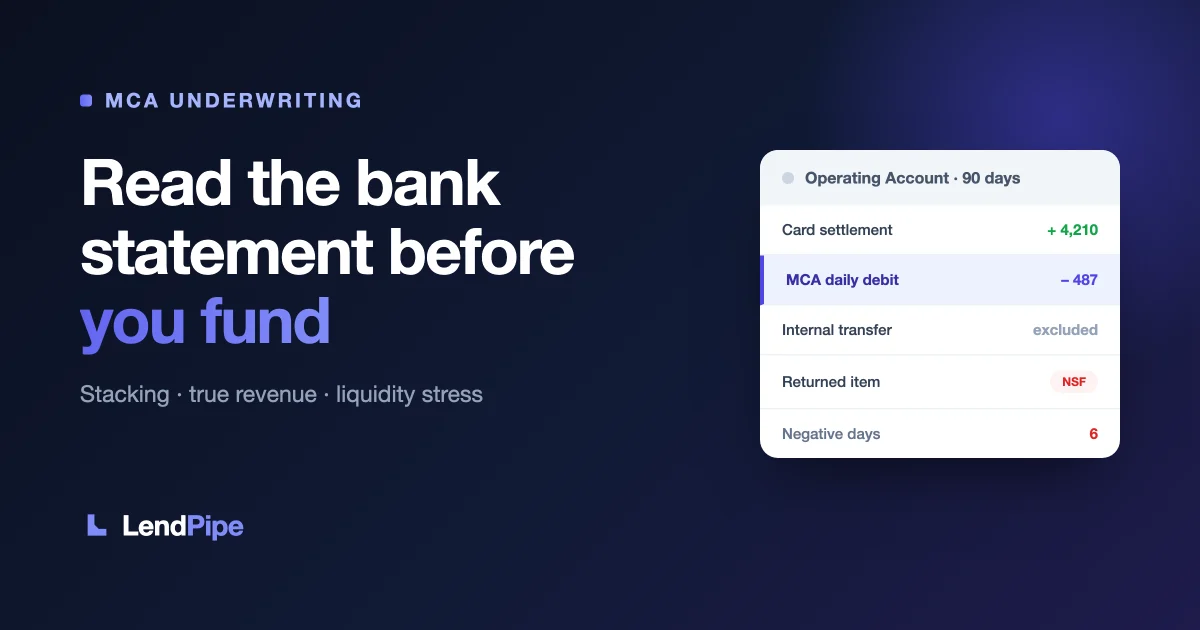
The Bank Statement Is the Underwrite
In most commercial lending, the bank statement is one input among many — it sits alongside tax returns, financial statements, and a personal financial statement. In merchant cash advance, the bank statement is the file. There's rarely a CPA-prepared financial. There's no audited balance sheet. The three to six months of business bank statements a broker forwards are, in practice, the entire basis for a same-day or next-day funding decision.
That raises the stakes on reading them correctly. An MCA is repaid through a fixed daily or weekly ACH pull against the merchant's account. The decision isn't "is this business profitable over the year" — it's "can this account sustain another fixed debit, every business day, on top of everything already hitting it." Answering that means reading the statements for a specific set of signals, fast, and without missing the one that matters.
The Four Questions an MCA File Has to Answer
Strip away the formatting and every MCA bank-statement review is trying to answer four questions.
1. What's already being pulled? (Stacking)
The single most important — and most dangerous to miss — question is whether the merchant already has open advances. "Stacking" a new position on top of two or three existing ones is how a fundable merchant becomes a default. Existing funders show up as recurring debits: the same amount, every business day or every week, often with an ACH descriptor that's abbreviated, truncated, or barely resembles the funder's actual name.
The trap is that these debits don't announce themselves. A daily $487 ACH labeled with a cryptic processor string looks like ordinary spend to a tired eye scrolling page forty of a PDF. A disciplined read identifies every recurring funder debit, reconstructs the daily or weekly amount, and totals the existing debit load — because a missed position isn't a small error, it's the difference between a performing deal and a charge-off.
2. What's the real revenue? (True revenue vs. gross deposits)
Brokers quote "monthly deposits." Underwriters need monthly revenue. Those are not the same number, and the gap is almost always in the merchant's favor when someone is trying to get a deal funded.
Gross deposits include transfers between the merchant's own accounts, factoring advances, loan and MCA proceeds, owner injections, and refunds. None of that is sales. Counting it as revenue inflates the merchant's apparent capacity and justifies a larger advance than the business can actually service. True revenue is what's left after the non-sales inflows are stripped out — the deposits that genuinely reflect the business selling something. Sizing the advance against true revenue, not gross inflow, is the discipline that keeps a portfolio performing.
3. Can the account take the hit? (Liquidity stress)
Even a real-revenue business can be a bad MCA risk if the account runs on fumes. The signals here are concrete and countable:
- Negative-balance days — how many days the account actually went negative across the statement window. A fixed daily pull against an account that's already dipping below zero is a deal that's engineered to bounce.
- NSFs and returned items — non-sufficient-funds events are the clearest tell that the existing obligations already exceed the cash on hand.
- Overdraft activity — frequent overdraft protection transfers say the same thing in a quieter voice.
A handful of these across three months is normal small-business noise. A cluster of them — especially at month-end, when fixed debits stack up — is a flashing warning that the account has no room for another remittance.
4. How durable is the revenue? (Concentration)
Two merchants with identical monthly revenue are not identical risks. One is settled daily by a card processor across thousands of customers; the other gets one large wire from a single client on the 5th of every month. The first has diversified, predictable cash flow that comfortably supports a daily pull. The second has a revenue stream that disappears the moment one relationship sours — and a daily debit schedule that doesn't care. Deposit concentration is the signal that separates them.
Why This Is Hard to Do by Hand — Under the Clock
None of the four questions is conceptually difficult. What makes MCA underwriting hard is doing all four, accurately, on every file, against a funding window measured in hours.
The statements arrive as scanned PDFs, phone photos, and multi-month packets stapled together out of order. A single merchant might have three accounts at two banks. The transactions that matter — the funder debits, the real revenue, the NSFs — are scattered across dozens of pages of noise. An analyst working manually has to scroll all of it, recognize funder descriptors from memory, mentally net out transfers, and count stress events, all while the broker is emailing for a decision. Under that pressure, discipline is the first thing to go: the position gets missed, the gross-deposit number gets used because it's faster, and the memo gets assembled in a hurry.
The answer isn't to slow down. It's to stop doing the mechanical reading by hand.
Reading the Statements Automatically
This is the problem LendPipe's bank statement analysis was rebuilt to solve for MCA files. Every transaction is extracted at the line level — including from the low-resolution scans and photographed statements that other tools choke on — and then labeled, not just transcribed:
- Existing positions are surfaced from the recurring funder debits, even when the ACH descriptor is abbreviated, so stacking is caught instead of missed.
- True revenue is computed by excluding internal transfers, factoring, and advance proceeds from the inflow, so the advance is sized against real sales.
- Liquidity stress — negative-balance days, NSFs, and overdrafts — is counted across the full statement window.
- Deposit concentration is measured so revenue durability is visible at a glance.
Every figure traces back to the transaction it came from, so the underwriter can verify any number in a click rather than re-reading the original statement. What lands on the screen is a structured read of the file, ready for judgment — not a wall of OCR text to be excavated.
From Read to Memo
The output of the read is only useful if it turns into a decision. Because the analysis already separates positions, true revenue, debit load, and stress, it feeds directly into a credit memo built specifically for cash advance underwriting — structured around the questions an MCA decision actually turns on, rather than a repurposed commercial-loan template. The analyst spends their time on the call, not on assembling the packet.
That's the shift that lets a desk move at funding speed without flying blind: the mechanical read is automated and consistent on every file, and the human judgment goes where it belongs — on whether to fund, how much, and at what factor.
See how LendPipe reads MCA files end to end in our merchant cash advance underwriting overview, or go deeper on the engine behind it in bank statement analysis.
Run the numbers